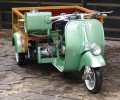
In cities where attention is fragmented and digital noise never stops, brands are beginning to rediscover something more tangible and human: physical presence. Not the kind that hides behind glass storefronts or static billboards, but one that moves through the street, pauses in public spaces, invites conversation, and becomes part of everyday urban life. This is where the custom APE Bajaj display vehicle finds its relevance.
Originally introduced as a compact utility platform inspired by the iconic Piaggio Ape, the three-wheeled APE format has evolved far beyond its practical roots. Today, it functions as a mobile environment for
storytelling, commerce, and immersive brand experience. At Scooter99, this transformation is not approached as traditional advertising, but as the design of a functional, adaptable space on wheels.
The appeal of the APE Bajaj lies in its scale and familiarity. Compact enough to navigate narrow streets and urban corners, yet visually distinctive enough to naturally draw attention, it offers a unique balance between presence and approachability. Rather than treating it as a surface for branding graphics, Scooter99 treats the vehicle as a structural framework — one that can be shaped into a mobile product display, a temporary exhibition booth, a pop-up retail space, a food and beverage cart, or an event and hospitality activation unit. The outcome is never generic; it is shaped by context, audience, and purpose.
What distinguishes a custom APE Bajaj from conventional mobile advertising is subtlety. Its strength is not in how loudly it promotes, but in how seamlessly it integrates into public space. It feels closer to a café cart, a market stall, or a traveling exhibit than a billboard demanding attention. People approach it out of curiosity, not obligation. Design decisions — from open side panels and canopy proportions to shelving configuration and counter height — are guided by how people physically move around the vehicle, where they pause, and how long they engage. In this approach, branding becomes structural rather than decorative.
Customization at Scooter99 is treated as a design collaboration rather than a preset package. Each handcrafted build considers display layout, material selection, weather protection, lighting design, and brand integration. Wood, metal, glass, or mixed materials are chosen based on operational use. Canopy systems are engineered for outdoor activation. Lighting is designed not only for function, but atmosphere — especially for evening events. The objective is coherence, ensuring the vehicle supports both brand identity and real-world usability without unnecessary visual excess.
Mobile display vehicles are particularly relevant today as brands shift toward experiential marketing. Unlike permanent retail spaces, a custom APE Bajaj allows businesses to test markets without long-term leases, appear at multiple locations or seasonal events, and combine offline engagement with online storytelling. Over time, the vehicle itself becomes recognizable — reappearing at festivals, hotel entrances, exhibitions, or launches — reinforcing brand memory through repetition and familiarity.
Although commonly associated with coffee or food carts, the versatility of a custom APE Bajaj extends far beyond F&B. It is used by lifestyle and fashion brands, property developers, hospitality environments, corporate event organizers, and cultural installations. Its scale makes it commercially functional while remaining personal and approachable — large enough to operate, small enough to feel human.
Perhaps most importantly, a well-designed APE Bajaj is not a temporary campaign prop but a long-term brand asset. Unlike short-term advertising placements, it continues to generate value over years of use. It becomes a reusable activation tool, a recognizable brand object, and a consistent visual presence across locations. In this sense, it operates less as advertising expenditure and more as design infrastructure.
Scooter99 approaches each build with an emphasis on craft, structural integrity, and practical function. Reinforced construction, export-ready standards, and careful detailing ensure the vehicle performs as reliably as it presents. Every project begins with a fundamental question: What is this vehicle meant to do in the real world? The clarity of that answer shapes every design decision that follows — transforming a compact three-wheeler into a moving space for experience, interaction, and lasting brand presence.

-120x100.jpeg)